Objectives & Actions
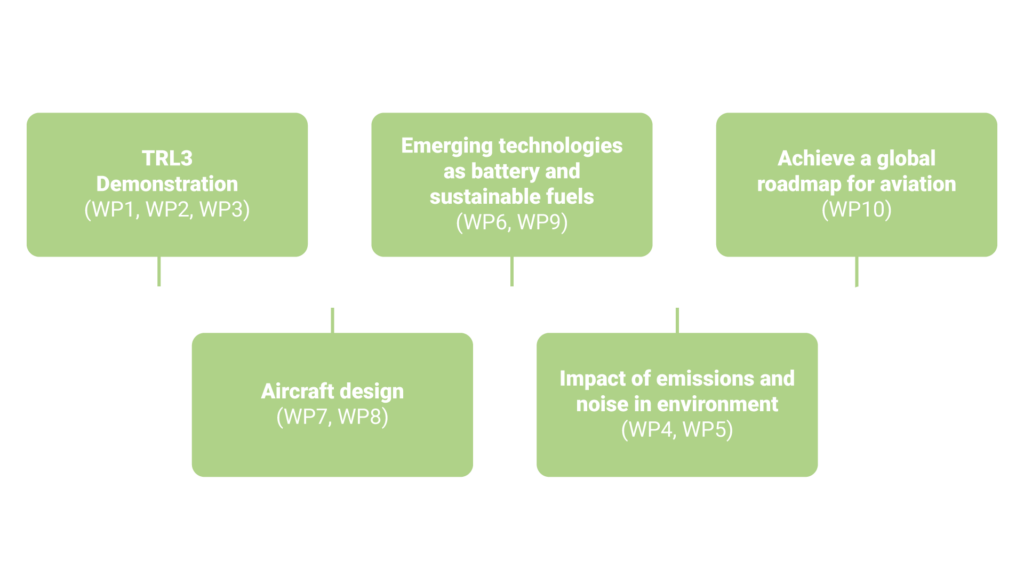
The EFACA project consists of 6 main objectives taking into consideration three TRL3 demonstrations relevant to the greening of aviation; a preliminary design propeller and jet driven airliners using hydrogen fuel; and a road map for achieving the EU environmental objectives for aviation.
In order to achieve the project’s six main objectives divided its three levels, 12 Work Packages are proposed, from which 10 have a direct influence on the technical achievements of the project.
Within the three TRL3 demonstrations of high relevance to the greening of aviation are:
Design, develop and test a world-first novel gearbox combining power inputs from a Gas Turbine Engine (GTE) and an Electric Engine (EE)
Improve performance and operating range of hydrogen fuel cells for aviation through a phase change new cooling method as alternative to current liquid cooling
Demonstrate in laboratory conditions a complete liquid hydrogen fuel system from cryogenic tank to fuel transfer, vaporization and combustion
The technologies considered include batery power for propilsion of small aircarft snf supply of electric energy for large aircraft
Design a regional aircraft using hybrid turbo-electric propulsion (HTEP) combining a gas turbine (GTE) and electric (EE) engines
Design a jet liner with using liquid hydrogen (LH) fuel including all the cryogenic systems
Use in large long-range jet airlines of SAF (synthetic aviation fuels), including biofuels and e-fuels procuded combining clean hydrgogen with carbon dioxide captured from the atmosphere.
The experimental demonstration (1-3) and advanced technologies (4-7) are taken as inputs to assess
The reduction of emissions, near airports and en-route, of all types: carbon, nitrogen and sulphur oxides, particles and contrails
The reduction of noise near airports, both for air and ground operations
The final synthesis is to build a global
Project Mapping